TerraMow V1000: smarter purchase without RTK – or not mature enough yet?
The TerraMow V1000 is one of the robotic mowers that seems to get almost everything right at first glance. No boundary wire, no RTK antenna, no GPS stress, but TerraVision 2.0 with triple camera, AI mapping, 3D obstacle detection, app control, 4G option, and a setup that the manufacturer claims can be completed in just a few minutes. This is exactly the type of product that is currently very well received: more modern than classic wired robots, simpler than many RTK systems, and technically much more exciting than older random models.
That’s why the TerraMow V1000 must be evaluated particularly soberly. Because when a model is heavily marketed based on comfort and AI, the crucial question is no longer whether the data sheet sounds modern. The more important question is: How well does the concept work in a real garden? And that’s where it gets interesting. The V1000 can be very convincing in suitable gardens. At the same time, it is not a magical universal robot that automatically and elegantly solves every difficult area.
This article therefore does not answer the advertising question, but the purchasing question: For whom is the TerraMow V1000 really worth it, where is it strong, where do real limits show, and when should you be more cautious despite the attractive concept?
What makes the TerraMow V1000 technically so interesting
The TerraMow V1000 is designed for lawns up to 1,200 m². Officially, it operates with TerraVision 2.0 triple-camera AI vision, 203 mm cutting width, 25 to 75 mm cutting height, 4.5 Ah battery, 120 minutes charging time, around 150 minutes runtime, IPX6 protection class, under 54 dB noise level, and a climbing ability of 18 degrees or 32.5%. Additionally, it features Wi-Fi, optional 4G use, OTA updates, rain sensor, and electric cutting height adjustment.
However, the most important point is not the bare list, but the concept behind it. The V1000 operates purely based on vision. It requires neither boundary wire nor RTK antenna. Instead, it is supposed to understand the garden through its cameras, AI evaluation, and continuous mapping. That’s what makes it so exciting. Because many buyers today want less installation, but also do not want the typical RTK problems with satellite reception, antenna positioning, and dead zones.
TerraMow is thus targeting buyers who say: I want wireless, but not necessarily the most expensive premium system. And that’s why the V1000 is a model that must be taken seriously not only technically but also strategically.
The biggest strength: no wire, no RTK, yet clearly modern navigation
The biggest advantage of the TerraMow V1000 is obvious: it saves you two of the most annoying aspects of many robotic mower concepts at the same time. No boundary wire and no RTK antenna. This is more than just marketing. Especially those who have ever laid a wire, later adjusted it, or cursed an RTK system due to poor positioning immediately understand why this concept is so attractive.
In an independent test by Notebookcheck, this was a real plus point. The AI mapping worked smoothly, the setup went well, and the navigation operated without the typical GPS-RTK issues. This is where the market logic of the V1000 lies: it aims to noticeably simplify installation and everyday use without sacrificing a more modern area logic.
This is particularly interesting for gardens where RTK would be rather unattractive, for example, due to dense trees, unfavorable house locations, or generally difficult reception conditions. TerraMow actively plays this strength. And to be fair: this is not a made-up sales argument, but a real advantage of the system.
For which gardens the TerraMow V1000 is particularly well suited
The V1000 is especially suitable for medium-sized gardens up to about 1,200 m² that are not completely simple but also not extremely problematic in layout. Several sub-areas, normal transitions, a few obstacles, trees, flower beds, or garden furniture are not fundamentally exclusion criteria for this concept. In these situations, the V1000 often feels like a very pleasant mix of modern technology and relatively low installation effort.
It fits particularly well for buyers who consciously do not want a wired system but also do not want the typical RTK setup. If your property is more under trees, partially shaded, or you generally value a clean, uncomplicated startup more than maximum high-end performance, the TerraMow V1000 is very relevant.
Also, for users who value app control and flexible settings, the model is interesting. According to tests and the manufacturer’s website, the app now offers significantly more options than earlier TerraMow systems: mowing direction, cutting patterns, map settings, edge parameters, and zone logic are much more finely adjustable than with many simpler robots.
What really convinces in everyday life
One must concede to the TerraMow V1000 that the basic idea not only sounds nice but also works really well in practice in several respects. The automatic mapping stands out particularly positively. In Notebookcheck’s practical test, the initial setup worked reliably and surprisingly precisely on two different test areas. Especially compared to older or immature wireless concepts, this is an important signal.
Another real plus point is the obstacle detection. In the test, typical everyday objects such as garden hoses, tennis balls, or even a hedgehog dummy were cleanly recognized and avoided. This is more than just a minor detail. Because especially with AI vision mowers, the quality of object recognition is a central difference between “sounds modern” and “actually works usefully.”
The app side also appears to be significantly more serious with the V1000 than with some young brands in early phases. This is evident not only in the test but also in how actively TerraMow is improving through firmware updates. The release notes from 2025 alone show that functions for mapping, zones, schedules, and stability have been further improved. This does not automatically mean perfection. But it does mean that the platform is visibly being developed further.
The first important limitation: it prefers rather flat than problematic areas
This is where it gets important. Because while the TerraMow V1000 is modern, it is not automatically ideal for every type of garden. An independent test clearly concludes that the V1000 prefers relatively flat properties. This is not a minor detail. Especially because TerraMow relies heavily on AI, vision, and wireless comfort, many quickly forget that even a modern system has limits on slopes, transitions, and uneven terrain.
The official climbing specification of 18 degrees or 32.5% is okay but not spectacular. Above all, it says little about real problem areas. In real gardens, the critical issues are often not uniform slopes but small edges, ground undulations, soft spots, transitions between areas, and slightly sloped edge zones. That’s where it shows whether a mower really works calmly or becomes annoying in everyday life.
So if your garden is not only large but also uneven, you should not simply read the V1000 as a universal problem solver. It is more of an intelligent comfort mower for suitable gardens than a specialist for difficult off-road areas.
The edge issue: highly configurable, but not magical
TerraMow aggressively promotes the edge mowing feature with the V1000. And to be fair: the model offers more adjustment options here than many competitors. According to tests and the manufacturer’s website, the edge parameters can be adjusted much more finely. This is a real advantage because edges are often the point where users become dissatisfied the fastest in practice.
However, one should not expect too much here either. Notebookcheck explicitly states that at transitions that are not flush with the ground, an edge of nearly 10 cm may still remain. This is not a special problem of TerraMow but is construction-related for many robots. But especially because the model sounds so modern, it is important not to accidentally sell too much perfection here.
The honest truth is: The TerraMow V1000 gives you more influence over edge behavior than many simple models. But it does not replace the trimmer in every garden. Especially with walls, raised beds, fences, overhanging plants, or non-passable boundaries, some touch-up work remains realistic.
What still doesn’t quite feel like a “finished classic”
The TerraMow V1000 does many things right, but it is still not a device that one should write about as if it were a decades-old mainstream model. The platform is still too young for that. While it is clear that the software is evolving, that is also a hint: the system is in motion.
The firmware release notes from TerraMow show several improvements around mapping, manual mapping closures, zone maintenance, scheduling, obstacle behavior, and stability during mowing and charging. This is positive. At the same time, it also shows that the V1000 does not seem as static and untouchable as an old, completely optimized classic. So those who buy today get a modern platform with noticeable development dynamics – and not necessarily a system where everything is already definitively “finished” on the software side.
That’s why one should be cautious with superlatives. The V1000 seems strong, but more in the sense of “very good modern concept with good development” than in the sense of “absolutely finished reference without open points.”
Another practical point: the station must be sensibly positioned during mapping
One detail that often gets overlooked in product texts but is important in practice: for the first mapping, the station must be placed on or very close to the lawn, according to independent tests. Later, the path to the area can be better defined in the app, but the basic logic of the station remains important. This sounds trivial, but it is relevant in everyday life.
Because many buyers automatically think of complete freedom in placement with wireless mowers. However, it is not that free after all. The TerraMow V1000 also needs a sensible docking and starting logic. If you want to place the station as hidden as possible far from the area, you should take this point seriously beforehand.
This is not a knockout criterion, but exactly the kind of practical detail that later decides between a relaxed or annoying everyday experience.
How strong is the mowing performance really?
When the garden is suitable, the mowing performance of the TerraMow V1000 is good to very decent. The 203 mm cutting width is not huge, but it fits the 1,000 to 1,200 m² class as long as the device is used as a regular maintenance mower and not misunderstood as a rescue machine for neglected areas. That’s what it is built for: regular, relatively quiet, planned maintenance mowing.
In the test, about 260 m² were mowed in around 2.5 hours, which fits well with the manufacturer’s specifications. This shows: The V1000 is not a pretender. It delivers real mowing performance. At the same time, one should not forget that larger areas, complex zones, and longer working paths always take time. Those looking for maximum area performance per hour will find other models. But for those who want modern navigation without wire and without RTK, this offers a pretty coherent package.
The noise level is also positive. Under 54 dB is pleasant in this class. A quiet mower is simply more relaxing in everyday life – especially in densely populated residential areas or when the robot operates at times when you still want to enjoy some daylight in the garden.
Don’t forget wear parts
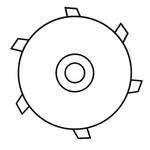
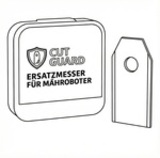
As with all robotic mowers, not only the platform but also the condition of the wear parts determines the mowing result. When blades become dull or the mowing disc no longer works cleanly, this is noticed in everyday life faster than many expect. That’s why it’s worth keeping an eye on the appropriate blade disc for TerraMow S800, S1200, and V1000 – especially if you are looking for a compatible set with protection and additional blades.
Especially with a device designed for clean, regular mowing, fresh blades and an intact mowing disc often bring more than any discussion about percentage figures in the data sheet.
For whom the TerraMow V1000 is a good choice
For gardens up to about 1,200 m² with a rather robot-friendly structure
For buyers who do not want boundary wire and no RTK antenna
For properties with trees or difficult satellite visibility, where RTK would be unattractive
For users who appreciate a modern app and many adjustment options
For people who consciously find a young but strong AI vision concept interesting
When you should look more closely or compare further
If your garden is significantly uneven, soft, or full of problematic transitions
If perfect edges without touch-up work are a must for you
If you are looking for a system that already feels like an old classic on the software side
If the station can only be positioned very unfavorably
If you are looking for maximum off-road tolerance rather than installation comfort
Conclusion: smart purchase or not mature enough yet?
The TerraMow V1000 is a really interesting model. Not only because it looks modern, but because the basic concept works much better in practice than many early wireless experiments. AI mapping, good obstacle detection, no RTK dependency, no cable installation, and a now significantly more serious app make it a strong candidate for many medium-sized gardens.
However, its limits are also real. The V1000 is more designed for relatively flat, reasonably structured gardens than for problematic sloped or transitional areas. Edges remain a topic here as well. And although the platform is noticeably maturing, it still feels more like a modern system with active development than like an ancient, completely optimized classic.
In summary, the TerraMow V1000 is a smart purchase if you are consciously looking for an AI vision model without wires and without RTK, and your garden fits well. It seems not mature enough especially if you expect absolute perfection or underestimate a difficult property. That’s where the strong concept separates from the wrong purchase with the V1000.
Short purchase recommendation in one sentence
The TerraMow V1000 is especially worthwhile for medium-sized, relatively flat gardens with a desire for wireless comfort without RTK – for perfectionists regarding edges or difficult problem areas, it is significantly less clear.







TerraMow V1000 in everyday life: a lot of AI, a lot of comfort – but where are the real limits?
TerraMow V1000: smarter purchase without RTK – or not mature enough yet?
The TerraMow V1000 is one of the robotic mowers that seems to get almost everything right at first glance. No boundary wire, no RTK antenna, no GPS stress, but TerraVision 2.0 with triple camera, AI mapping, 3D obstacle detection, app control, 4G option, and a setup that the manufacturer claims can be completed in just a few minutes. This is exactly the type of product that is currently very well received: more modern than classic wired robots, simpler than many RTK systems, and technically much more exciting than older random models.
That’s why the TerraMow V1000 must be evaluated particularly soberly. Because when a model is heavily marketed based on comfort and AI, the crucial question is no longer whether the data sheet sounds modern. The more important question is: How well does the concept work in a real garden? And that’s where it gets interesting. The V1000 can be very convincing in suitable gardens. At the same time, it is not a magical universal robot that automatically and elegantly solves every difficult area.
This article therefore does not answer the advertising question, but the purchasing question: For whom is the TerraMow V1000 really worth it, where is it strong, where do real limits show, and when should you be more cautious despite the attractive concept?
What makes the TerraMow V1000 technically so interesting
The TerraMow V1000 is designed for lawns up to 1,200 m². Officially, it operates with TerraVision 2.0 triple-camera AI vision, 203 mm cutting width, 25 to 75 mm cutting height, 4.5 Ah battery, 120 minutes charging time, around 150 minutes runtime, IPX6 protection class, under 54 dB noise level, and a climbing ability of 18 degrees or 32.5%. Additionally, it features Wi-Fi, optional 4G use, OTA updates, rain sensor, and electric cutting height adjustment.
However, the most important point is not the bare list, but the concept behind it. The V1000 operates purely based on vision. It requires neither boundary wire nor RTK antenna. Instead, it is supposed to understand the garden through its cameras, AI evaluation, and continuous mapping. That’s what makes it so exciting. Because many buyers today want less installation, but also do not want the typical RTK problems with satellite reception, antenna positioning, and dead zones.
TerraMow is thus targeting buyers who say: I want wireless, but not necessarily the most expensive premium system. And that’s why the V1000 is a model that must be taken seriously not only technically but also strategically.
The biggest strength: no wire, no RTK, yet clearly modern navigation
The biggest advantage of the TerraMow V1000 is obvious: it saves you two of the most annoying aspects of many robotic mower concepts at the same time. No boundary wire and no RTK antenna. This is more than just marketing. Especially those who have ever laid a wire, later adjusted it, or cursed an RTK system due to poor positioning immediately understand why this concept is so attractive.
In an independent test by Notebookcheck, this was a real plus point. The AI mapping worked smoothly, the setup went well, and the navigation operated without the typical GPS-RTK issues. This is where the market logic of the V1000 lies: it aims to noticeably simplify installation and everyday use without sacrificing a more modern area logic.
This is particularly interesting for gardens where RTK would be rather unattractive, for example, due to dense trees, unfavorable house locations, or generally difficult reception conditions. TerraMow actively plays this strength. And to be fair: this is not a made-up sales argument, but a real advantage of the system.
For which gardens the TerraMow V1000 is particularly well suited
The V1000 is especially suitable for medium-sized gardens up to about 1,200 m² that are not completely simple but also not extremely problematic in layout. Several sub-areas, normal transitions, a few obstacles, trees, flower beds, or garden furniture are not fundamentally exclusion criteria for this concept. In these situations, the V1000 often feels like a very pleasant mix of modern technology and relatively low installation effort.
It fits particularly well for buyers who consciously do not want a wired system but also do not want the typical RTK setup. If your property is more under trees, partially shaded, or you generally value a clean, uncomplicated startup more than maximum high-end performance, the TerraMow V1000 is very relevant.
Also, for users who value app control and flexible settings, the model is interesting. According to tests and the manufacturer’s website, the app now offers significantly more options than earlier TerraMow systems: mowing direction, cutting patterns, map settings, edge parameters, and zone logic are much more finely adjustable than with many simpler robots.
What really convinces in everyday life
One must concede to the TerraMow V1000 that the basic idea not only sounds nice but also works really well in practice in several respects. The automatic mapping stands out particularly positively. In Notebookcheck’s practical test, the initial setup worked reliably and surprisingly precisely on two different test areas. Especially compared to older or immature wireless concepts, this is an important signal.
Another real plus point is the obstacle detection. In the test, typical everyday objects such as garden hoses, tennis balls, or even a hedgehog dummy were cleanly recognized and avoided. This is more than just a minor detail. Because especially with AI vision mowers, the quality of object recognition is a central difference between “sounds modern” and “actually works usefully.”
The app side also appears to be significantly more serious with the V1000 than with some young brands in early phases. This is evident not only in the test but also in how actively TerraMow is improving through firmware updates. The release notes from 2025 alone show that functions for mapping, zones, schedules, and stability have been further improved. This does not automatically mean perfection. But it does mean that the platform is visibly being developed further.
The first important limitation: it prefers rather flat than problematic areas
This is where it gets important. Because while the TerraMow V1000 is modern, it is not automatically ideal for every type of garden. An independent test clearly concludes that the V1000 prefers relatively flat properties. This is not a minor detail. Especially because TerraMow relies heavily on AI, vision, and wireless comfort, many quickly forget that even a modern system has limits on slopes, transitions, and uneven terrain.
The official climbing specification of 18 degrees or 32.5% is okay but not spectacular. Above all, it says little about real problem areas. In real gardens, the critical issues are often not uniform slopes but small edges, ground undulations, soft spots, transitions between areas, and slightly sloped edge zones. That’s where it shows whether a mower really works calmly or becomes annoying in everyday life.
So if your garden is not only large but also uneven, you should not simply read the V1000 as a universal problem solver. It is more of an intelligent comfort mower for suitable gardens than a specialist for difficult off-road areas.
The edge issue: highly configurable, but not magical
TerraMow aggressively promotes the edge mowing feature with the V1000. And to be fair: the model offers more adjustment options here than many competitors. According to tests and the manufacturer’s website, the edge parameters can be adjusted much more finely. This is a real advantage because edges are often the point where users become dissatisfied the fastest in practice.
However, one should not expect too much here either. Notebookcheck explicitly states that at transitions that are not flush with the ground, an edge of nearly 10 cm may still remain. This is not a special problem of TerraMow but is construction-related for many robots. But especially because the model sounds so modern, it is important not to accidentally sell too much perfection here.
The honest truth is: The TerraMow V1000 gives you more influence over edge behavior than many simple models. But it does not replace the trimmer in every garden. Especially with walls, raised beds, fences, overhanging plants, or non-passable boundaries, some touch-up work remains realistic.
What still doesn’t quite feel like a “finished classic”
The TerraMow V1000 does many things right, but it is still not a device that one should write about as if it were a decades-old mainstream model. The platform is still too young for that. While it is clear that the software is evolving, that is also a hint: the system is in motion.
The firmware release notes from TerraMow show several improvements around mapping, manual mapping closures, zone maintenance, scheduling, obstacle behavior, and stability during mowing and charging. This is positive. At the same time, it also shows that the V1000 does not seem as static and untouchable as an old, completely optimized classic. So those who buy today get a modern platform with noticeable development dynamics – and not necessarily a system where everything is already definitively “finished” on the software side.
That’s why one should be cautious with superlatives. The V1000 seems strong, but more in the sense of “very good modern concept with good development” than in the sense of “absolutely finished reference without open points.”
Another practical point: the station must be sensibly positioned during mapping
One detail that often gets overlooked in product texts but is important in practice: for the first mapping, the station must be placed on or very close to the lawn, according to independent tests. Later, the path to the area can be better defined in the app, but the basic logic of the station remains important. This sounds trivial, but it is relevant in everyday life.
Because many buyers automatically think of complete freedom in placement with wireless mowers. However, it is not that free after all. The TerraMow V1000 also needs a sensible docking and starting logic. If you want to place the station as hidden as possible far from the area, you should take this point seriously beforehand.
This is not a knockout criterion, but exactly the kind of practical detail that later decides between a relaxed or annoying everyday experience.
How strong is the mowing performance really?
When the garden is suitable, the mowing performance of the TerraMow V1000 is good to very decent. The 203 mm cutting width is not huge, but it fits the 1,000 to 1,200 m² class as long as the device is used as a regular maintenance mower and not misunderstood as a rescue machine for neglected areas. That’s what it is built for: regular, relatively quiet, planned maintenance mowing.
In the test, about 260 m² were mowed in around 2.5 hours, which fits well with the manufacturer’s specifications. This shows: The V1000 is not a pretender. It delivers real mowing performance. At the same time, one should not forget that larger areas, complex zones, and longer working paths always take time. Those looking for maximum area performance per hour will find other models. But for those who want modern navigation without wire and without RTK, this offers a pretty coherent package.
The noise level is also positive. Under 54 dB is pleasant in this class. A quiet mower is simply more relaxing in everyday life – especially in densely populated residential areas or when the robot operates at times when you still want to enjoy some daylight in the garden.
Don’t forget wear parts
As with all robotic mowers, not only the platform but also the condition of the wear parts determines the mowing result. When blades become dull or the mowing disc no longer works cleanly, this is noticed in everyday life faster than many expect. That’s why it’s worth keeping an eye on the appropriate blade disc for TerraMow S800, S1200, and V1000 – especially if you are looking for a compatible set with protection and additional blades.
Especially with a device designed for clean, regular mowing, fresh blades and an intact mowing disc often bring more than any discussion about percentage figures in the data sheet.
For whom the TerraMow V1000 is a good choice
When you should look more closely or compare further
Conclusion: smart purchase or not mature enough yet?
The TerraMow V1000 is a really interesting model. Not only because it looks modern, but because the basic concept works much better in practice than many early wireless experiments. AI mapping, good obstacle detection, no RTK dependency, no cable installation, and a now significantly more serious app make it a strong candidate for many medium-sized gardens.
However, its limits are also real. The V1000 is more designed for relatively flat, reasonably structured gardens than for problematic sloped or transitional areas. Edges remain a topic here as well. And although the platform is noticeably maturing, it still feels more like a modern system with active development than like an ancient, completely optimized classic.
In summary, the TerraMow V1000 is a smart purchase if you are consciously looking for an AI vision model without wires and without RTK, and your garden fits well. It seems not mature enough especially if you expect absolute perfection or underestimate a difficult property. That’s where the strong concept separates from the wrong purchase with the V1000.
Short purchase recommendation in one sentence
The TerraMow V1000 is especially worthwhile for medium-sized, relatively flat gardens with a desire for wireless comfort without RTK – for perfectionists regarding edges or difficult problem areas, it is significantly less clear.